For years, people have questioned the long-term viability of the Social Security system. While you generally can’t do anything about that, there are some steps you can take to maximize your Social Security benefits.
People approaching retirement age often have questions about benefits they may be eligible to receive from the Social Security Administration (SSA). Here are the answers to several common inquiries.
How Soon Can I Start Collecting Retirement Benefits?
If you want to receive full retirement benefits from the SSA, you have to wait until you reach the full retirement age (FRA). But you may apply for benefits as early as age 62. Starting early will reduce your monthly benefits by as much as 30%, but, of course, you will receive benefits for more years. Your tax adviser can help figure out the exact monthly benefit reduction and help you determine if you likely will be better off waiting until your FRA to start taking benefits.
What Is My FRA?
Your FRA depends on the year in which you were born.
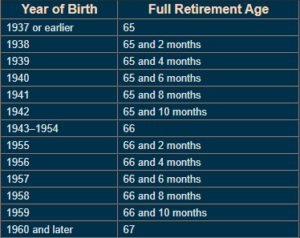
If you were born on January 1 of any year, refer to the previous year. If you were born on the first of the month, the SSA figures your benefit (and your FRA) as if your birthday were in the previous month.
How and When Do I Apply for Social Security Retirement Benefits?
Apply for retirement benefits three months before you want your payments to start. The SSA may request certain documents in order to pay benefits, including:
- Your original birth certificate or other proof of birth,
- A marriage certificate or divorce decree when applying for spousal benefits,
- Proof of U.S. citizenship or lawful alien status if you were not born in the United States,
- A copy of your U.S. military service paper(s) if you performed military service before 1968, and
- A copy of your W-2 Form(s) and/or self-employment tax return for the prior year.
For most retirees, the easiest way to apply for benefits is by using the online application.
What Happens if I Receive Social Security Retirement Benefits While Still Working?
If you’re under FRA and earn more than the annual limit (subject to inflation indexing), your benefits will be reduced, as follows:
- If you’re under FRA for the entire year, you forfeit $1 in benefits for every $2 earned above the annual limit. For 2021, the limit is $18,960, up from $18,240 in 2020.
- In the year in which you reach FRA, you forfeit $1 in benefits for every $3 earned above a separate limit, but only for earnings before the month you reach FRA. The limit in 2021 is $50,520, up from $48,600 in 2020.
Beginning with the month in which you reach FRA, you can receive your benefits without regard to your earnings.
Can I Collect More Benefits if I Retire After My FRA?
You can receive increased monthly benefits by applying for Social Security after reaching FRA. The benefits could increase by as much as 32% if you wait until age 70, but of course you will receive benefits for fewer years. After age 70, there are no more increases. We can help calculate the payout for waiting to collect your retirement benefits and help you determine if you likely will be better off waiting beyond your FRA to start taking benefits.
Can I Manage Retirement Benefits for an Incapacitated Person?
If a Social Security recipient needs help managing their retirement benefits — perhaps an elderly parent — contact your local Social Security office. You must apply to become that person’s representative payee in order to assume responsibility for using the funds for the recipient’s benefit.
Do I Qualify for Social Security Survivors Benefits?
A spouse and children of a deceased person may be eligible for benefits based on the deceased’s earnings record as follows:
A widow or widower can receive benefits:
- At age 60 or older,
- At age 50 or older if disabled, or
- At any age if she or he takes care of a child of the deceased who is younger than age 16 or disabled.
A surviving ex-spouse could also be eligible for benefits under certain circumstances. In addition, unmarried children can receive benefits if they are:
- Younger than age 18 (or up to age 19 if they are attending elementary or secondary school full-time), or
- Any age and were disabled before age 22 and remain disabled.
Under certain circumstances, benefits also can be paid to adopted children, stepchildren, grandchildren, or stepgrandchildren. In addition, dependent parents age 62 or older who received at least one-half support from the deceased may be eligible to receive benefits.
A one-time payment of $255 may be made only to a spouse or child if they meet certain requirements. Survivors must apply for this payment within two years of the date of death.
Are Social Security Benefits Subject to Income Tax?
You will be taxed on Social Security benefits if your provisional income (PI) exceeds the thresholds within a two-tier system.
PI between $32,000 and $44,000 ($25,000 and $34,000 for single filers). Recipients in this range are taxed on the lesser of 1) one-half of their benefits or 2) 50% of the amount by which PI exceeds $32,000 ($25,000 for single filers).
PI above $44,000 ($34,000 for single filers). Recipients above this threshold are taxed on 85% of the amount by which PI exceeds $44,000 ($34,000 for single filers) plus the lesser of 1) the amount determined under the first tier or 2) $6,000 ($4,500 for single filers).
PI equals the sum of 1) your adjusted gross income, 2) your tax-exempt interest income, and 3) one-half of the Social Security benefits received.
If you have additional questions about receiving Social Security retirement benefits, contact us. We can help you navigate the application process and understand tax issues related to receiving retirement benefits.
Hoberman & Lesser’s NYC accountants serve a broad cross section of businesses, ranging from publicly held companies, to private sector businesses, to individual entrepreneurs throughout New York, New Jersey, and Connecticut, and across the United States. To schedule a complimentary and confidential consultation with a member of our team, please contact us.