
Hoberman & Lesser’s Story
The history of Hoberman & Lesser began in 1930 when an enterprising man launched his own business out of necessity and opportunity. Louis G. Hoberman, a former chemist, and established accountant opened an accounting firm in New York, NY, under the name Louis G. Hoberman & Company.
Today, 95 years later, Hoberman & Lesser has become a highly-regarded and well-respected accounting and advisory firm serving a cross-section of entities. The Firm’s clients include publicly-held companies, private sector businesses, and individual entrepreneurs throughout the New York metropolitan region, across the United States, and the world. Though things have changed dramatically since 1930, what has not changed is our commitment to providing the highest quality client service to our valued clients.
As we look forward to the future, we would like to take this opportunity to reminisce by sharing our Firm’s history. The ‘Hoberman & Lesser Story’ is inextricably linked to Robert Hoberman, the Firm’s Managing Partner, and his own family history.
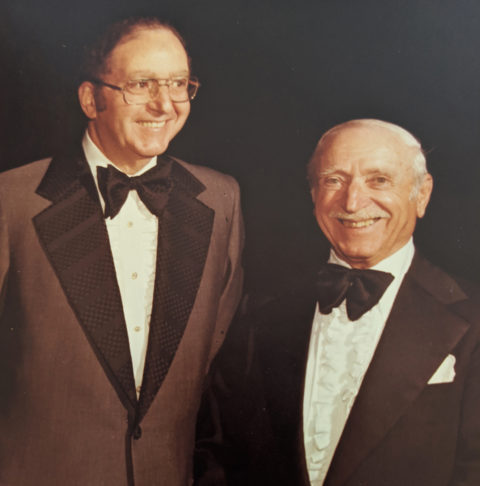
Bernard Hoberman; Louis G. Hoberman
Prior to World War I, Louis G. Hoberman was one of many chemists working for a large chemical company. On November 11, 1918, when the armistice was signed to end the war, the chemical company gathered Louis G. and eleven of his colleagues into one room and fired them. After World War I, jobs were scarce, and the economy began to decline. Louis G.’s wife, Lena, a bookkeeper at the time, suggested that he become an accountant because “they always seem to have a job.” Louis G. returned to school to earn an accounting degree, and he became close to one of his professors who owned an accounting firm. With an obligation to provide financial stability for his wife and two sons, Louis G. asked his professor for a job. Fortunately, Louis G.’s request came at the perfect time. The professor had a client, a men’s hat company owned by three brothers, whose books were in disarray. The professor proposed that if Louis G. could clean-up the company’s books within one year, he would offer Louis G. a position as an accountant at his firm.
Louis G. embraced his first accounting opportunity and began working for the three brothers. The 1920’s marked a new era of fashion, and for men, well-fitting hats were an essential staple. Louis G. worked diligently on the hat company’s books and helped their business flourish. After a year, he asked his professor about the position he was initially promised. The professor said yes, and promptly offered Louis G. a position as a staff accountant with his accounting firm. Louis G. told the owners of the men’s hat company that he would soon be leaving to accept a new position as an accountant with his professor’s firm. They realized they would lose a valuable employee, therefore, they incentivized him to stay with a 25% ownership interest in their business. Louis G. accepted the opportunity and turned down his professor’s offer.
Louis G. worked for the men’s hat company for a while; however, soon men stopped wearing hats. He told the three brothers that there was enough money to provide for three families, but not enough for four. Louis G. offered back his share and became an accountant.
He then asked them to be his client as well as the companies who made the rims, bands, and materials for the hats. Many of them agreed! At the time, he was not a CPA, and at that time, you needed to work with a CPA for a number of years in order to earn your CPA license. Since Louis G.’s cousin was a CPA, he proposed that they form a partnership and start their own accounting firm. After a couple of years, Louis G. gained his certification and convinced his cousin to part ways since they had been working on very different clients at the time. In 1930, Louis G. Hoberman started his own accounting firm, called Louis G. Hoberman & Company, and brought his personal clients with him.
Louis G.’s son, Bernie Hoberman, grew up in Brooklyn, enlisted in the army, and then graduated from New York University with an accounting degree. Bernie then began working at his father’s company. They worked well together– Louis G. was known as a nice guy who built the business from the ground up, and Bernie was the go‐getter who continued to grow the business. In the 1970’s, Louis G. retired. Bernie had already taken over the business. In the 1950’s, he moved the business from Brooklyn to Manhattan, and in 1970 he became partners with Ruben Miller. In 1981, Bernie’s son, Robert Hoberman joined the Firm. Two years later, Robert became a partner, and in 1990, Robert became the Managing Partner. In 1992, Robert bought out Ruben Miller, who then retired.
In 1993, Robert met Steve Lesser, and he joined the Firm as a Partner. The Firm was renamed Hoberman & Lesser, LLP.